I've moved this blog here: http://blog.deanandadie.net/category/dean/brewing/
19 April, 2010

11 April, 2010
Barrelling Day

All those fermenting vessels under the looming Merlot barrel contain Russian Imperial Stout. Yesterday the TAbc drained the beer into that barrel to condition over the summer. The first task of the day was to sanitize the barrel with 20 gallons of boiling water.


The barrel sits high on its rack making gravity transfer tricky. The duck-in cooler gave us the necessary height.
 Surprisingly little beer spilled, but what did come out flew across the room, landing on Ruth.
 After a long day of barreling, the beer came to rest in my cold room, where it will sit until we bottle it in October.
I bottled a 12-pack pre-barrel for comparison.
20 March, 2010
Alt Two

My second try at an Altbier turned out better than the first. Alt One got an infection from the MiniBrew plastic conicals I was using. A tragedy, because it tasted so good coming out of the kettle.
Alt Two is not my own recipe, but a concoction from Jamil Zainasheff's Brewing Classic Styles. Scaled up to 10 gallons the recipe is:
Fermentables
- 18 lbs Pilsner
- 2 lbs Munich
- 0.5 lbs Debittered Black malt
- 0.5 lbs Caramunich 60L
- 6 oz Pale Chocolate malt 200L
Hops
- 2.5 oz 8.1% AA Perle 60 minutes
Pitch a 1600ml starter of WLP 029 German Ale yeast into 14.3% B original gravity wort.
Fermented two weeks between 58º & 66ºF. Lagered for 26 days.
Notes
- 2010-02-15 9.6%B Vinous notes
- 2010-03-13 8%B Vinous flavors reduced. Ready to package.
For my third Altbier I will find a common ground between One and Two. Not so much roasted malt as #2 and not so much Munich or Vienna as #1.
08 March, 2010
Tasting & Bottling Something Else
It is 14.6° Plato and Something Else is three weeks old. Starting at 25.2º P, the big gravity beer weighs in at a small 6.2% ABV. Before putting it all away for conditioning a little evaluation is in order.
There is a little ester in the nose. No hop aroma. The uncarbonated beer is sweet, bitter, roasty, "stout-like", and lacks much fermentation character. Tastes a little like an over-hopped milk stout might. It sticks to your mouth.
It is close enough to be a Russian Imperial Stout, but lacks nuance due to the simplistic grainbill.
I have about 80 fluid ounces to bottle. The small volume batch is a breeze to work with. Next time I will remember to add priming sugar. Not to worry, the gravity is still drifting downward.
15 February, 2010
The Domestic & Something Else
Read from the bottom up: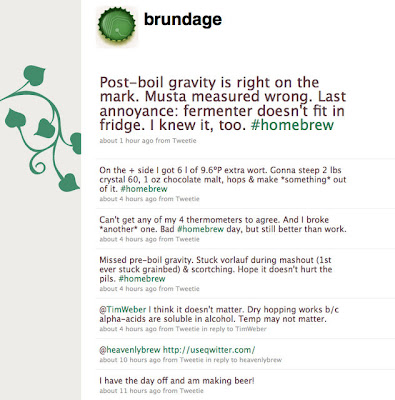 Today I brewed The Domestic for a second time. It is a Classic American Pilsner, also called a Pre-Prohibition Lager. The recipe is from Jamil Zainasheff's book Brewing Classic Styles.
- 12.5º Plato OG
- 80% German Pilsner
- 20% Flaked Maize
- Rest at 148ºF for 60 minutes
- Mash out to 160ºF
- Collect 11.5 gllons
- 2 oz 8.1% AA Perle FWH
- 0.5 oz 3.8% AA Czech Saaz 30 mins
- 1 oz 3.8% Czech Saaz 10 mins
My mash tun is direct-fired and I recirculate the wort to prevent scorching. During vorlauf today my flow rate slowed to a trickle. Most of the time the March pump loses prime and I goose it a little to get it going again. When that didn't work I stirred the grainbed and restarted the vorlauf. None of the usual tricks got the wort flowing again. But this was no ordinary problem.

That piece of hose pokes through the mash tun's false bottom, acting as the pick-up. Heat from the burner melted it partially closed. Wort in the bottom of my tun scorched from lack of movement.

The sparge marched onward and I collected 11.5 gallons of sweet wort. I measured the gravity at 9.6º Plato, or 1.038. At that strength my post-boil gravity comes out to 1.043; 7 points too low. Reducing the volume to hit the gravity posed two problems. First, the style demands a light-colored beer and a prolonged boil would darken it too much. Secondly, the first hops were in the kettle and would throw off the bitterness balance. I cursed a little, tweeted then pushed on.
Ninety minutes later the brew was boiled then chilled and in the fermenter. When I lowered it into the converted chest freezer the bulges of the keg would not fit. Previously, I had tried to put the keg in the freezer with the same result, so I should have known. I grumbled a little.

It is now in my ale fermentation cooler, turned up to full blast cooling. When it comes time to lager this baby, I'll split it into two carboys and put them in the freezer. Notice I hit my target starting gravity of 12.5º B.
After collecting the desired pre-boil volume I became curious how much wort I had left in the mash. Opening the spigot on the tun I dumped 6 liters of 9.6º B pale sweet wort into a bucket. With everything that went wrong today I was not about to waste so much potential beer.
Looking at my grain store, I picked an additional 2 lbs Crystal 60ºL and one ounce of chocolate malt. Approximating the recipe gives this:
- 2 lbs German Pilsner
- 2 lbs Crystal 60º L
- 1 oz Chocolate
- 0.3 oz 9.1% AA Centennial 60 mins
- 0.5 oz 9.1% AA Centennial 15 mins
- 0.5 oz 4.5% AA Fuggles 10 mins
- 0.5 oz 4.5 %AA Fuggles 1 min

The final gravity turned out to be 25.2º P (1.107). It will probably be an Imperial Stout-ish. The yeast is a German ale/kölsh strain coming right out of an Altbier I put into lager tonight. Hope it can handle high gravity.
As an aside, I am quite fond of the brew-in-a-bag method those Aussies invented. Tonight's second brewsession was essentially that.

29 December, 2009
New Site For Brewing Questions: BrewAdvice.com
A few people I follow on Twitter set up a nifty new site designed around brewing questions. Using technology from StackOverflow the best answers bubble up to the top of each question, meaning you need not search through a lengthy forum post to find the right answer.
Surf on over to BrewAdvice or check out my profile there.
09 December, 2009
Basic Equipment
One of my friends asked what equipment she should get her boyfriend so he could start making beer. There are many equipment articles out there and here is one more
Note: If I were to write this up again, I would recommend the Australian brew-in-a-bag method rather than all the all-grain equipment.
I don't know what your budget is... you can easily spend a few hundred dollars for a good kitchen setup.
The Minimum:
A large pot. Stainless steel is best, but aluminum is cheap. Like I said before, at least 2 gallons. The bigger, the better. Best is 6 gallons so he can do a full-wort boil where he doesn't have to top off the fermenter with tap water. Boiling 5 gallons of wort on a kitchen stove is a big pain though, consider getting one of those turkey fryer burner deals. The one I used to have was a 7-gallon aluminum pot and a burner. Never did fry a turkey.
A fermenter. Go for the 6 gallon variety. I used glass carboys, but I have heard very good things about the Better Bottle. If I needed another (cheap) fermenter, I'd try one out. The homebrew shop will probably tell you need a primary & secondary fermenter, but that's a big myth. I do my fermentations in a single vessel and make pretty good (damn good) beer. Politely decline.
Transfer tubing, bottling wand and a racking cane. Not too much to say here - the homebrew shop will know what you need. I recommend a stainless steel racking cane over a plastic one. It's worth the extra money.
A bottling bucket.
Bottles. Five gallons of beer fills a little fewer than fifty bottles.
Sanitizer. Go for the "no rinse" variety. I switch between iodophor and 5-Star to keep the nasties on their toes. Buy in bulk.
Testing equipment. A floating thermometer or a digital thermometer on a probe. Also a hydrometer and a cheap graduated cylinder to take specific gravity readings in. Long ago I ditched the cylinder & hydrometer in favor of a refractometer. Really worth the extra money (but maybe only if you've been using a hydrometer for a while :-)
That equipment will be enough to get him started doing "extract with specialty grain" (also incorrectly known as "partial mash") brewing. The recipe kits are classified by the level of equipment you have. Since he's got some brewery experience he will probably want to get into "all grain" brewing pretty soon. All of the above equipment will serve for that purpose, plus a few additional pieces.
All Grain
You definitely need the full sized pot.
A hot liquor tank (HLT). Ideally this is a vessel you can heat, but anything that keeps 3-5 gallons of hot water is fine. Many people use Rubbermaid or Gott coolers.
A mash tun. This is a vessel to hold the grain and hot water for making sweet wort. It's slightly specialized because you need a filter at the bottom used to separate the sweet wort from the spent grain. If either of you is crafty you can make one on the cheap. Mine was a large cooler with the drain plug removed replaced by some copper fittings. Some rigid copper tubing with small holes drilled in it sat in the bottom connected to a brass ball valve on the outside. Served me well for five years.
Here's a good shot of my previous all-grain setup. Left to right in the picture is a 5-gallon aluminum pot that I punched a hole in for the drain and spigot. It served as my HLT. Next is my mash tun which I described above. Lastly is a 10-gallon aluminum pot sitting on a burner. It also has a drain and spigot.
Consider a subscription to Zymmurgy or BYO Magazine. One of the books I recommend to everyone is Designing Great Beers. Really helped me understand the process.
Get involved in a homebrew club. They are the best places to learn the hobby. There are at least two in Oakland: The Draught Board & Bay Area Mashers (BAM). If you go to a Draught Board meeting tell Roger St Dennis I say hi.
I've gone on for a while now. There are a billion other brewing resources on the web.
- Brew Advice A good Q&A site.
- Homebrew Talk Great forum & brewing wiki
- More Beer I used to buy what I couldn't get locally from them. (Now Austin Homebrew Supply is closer.)
- The Homebrew Digest Hangout for some old, old veterans of brewing.
- The American Homebrewer's Association A good advocacy group

21 October, 2009
Triple Digits Tasting Notes
Triple Digits is gone. It was good with room for improvement. The hop bitterness was a little harsh and it should bee lighter. Here are some tasting notes:
- spicy clove phenolics
- alcohol warmth
- yeast aroma
- fine, thin head
- effervescent
- creamy malt, finishing dry
- medium body
- earthy hop bitterness lingers in the back of your throat
20 October, 2009
Oktoberfest At Christopher's World Grille
Thanks to everyone for coming out to see me talk at Christopher's tonight. For an Italian, he makes some delicious German food.
If you want to know more about making beer at home, read this post and come out for Teach A Friend to Homebrew Day on November 7th. The Texas Aggieland Brew Club will be making beer in front of the Village Cafe/Art 979 Gallery in downtown Bryan starting at 11am. If you can't make that we hold regular meetings on the third Friday of the month. We are organized through Facebook only right now, but if you get in touch with me I will make sure you know what is going on.
I hope you enjoyed the dinner as much as I did. I can do the same for your restaurant. I also train staff and give general beer menu advice. Drop me an email.
10 October, 2009
I Could Make Great Vinegar
The nettle beer came down with an acetobacter infection. This is not a surprise because fermentation conditions almost encouraged it. When I made the beer, I was out of carboys after making a Newcastle Brown ale clone. Under the circumstances I used a 5-gallon bucket. Normally these vessels can make great beer, however none of my buckets have lids. I improvised a "seal" with some plastic wrap. The beer was okay when I added dry hops to it a week after fermenting and I suspect opening the seal introduced the infection.
In the interest of Science I have a few ounces of the witch's brew in my cup and take furtive sips to get a taste for how the beer may have turned out. My eyes are a little watery. It isn't balsamic strength, still very much a vinegar. All the alcohol became acetic acid but there is a underlying malt taste and something else which I can only attribute to the nettles. Sandwiched between the initial vinegar sourness and the finishing vinegar bite is a vegetal-peppery note that reminds me of the brew day. Hop bitterness is non-existent and there is a softness to it that you don't get when consuming straight vinegar, which I do on occasion.
It was an experiment that failed. The follow-up experiment will improve it. Things I will change:
- A proper lauter - I strained my grains through a colander.
- Closed fermentation.
- Nettles at knockout instead of the boil.
29 September, 2009
If You Saw Me On The TeeVee
Thanks for finding me (see the interview video if you are a regular reader). Homebrewing is a rewarding, useful hobby. It can be easy or intricate, scientific or artful. For the impatient, join the Texas Aggieland Brew Club on Facebok and read about the process on HowToBrew. Or get in touch with me personally.
The beer you saw me making was a three gallon batch of nettle beer. It is a recipe I want to start experimenting with. The beer I drank throughout the interview was a Belgian Tripel. Typically, homebrewers make five gallons of beer at a time so most of the equipment is sized appropriately.
To get started making your own beer you need a few specialized tools and some basic kitchen gadgets. Homebrew specialty stores sell equipment kits that will get you started. Check out Austin Homebrew Supply - they have a good web store and it only takes a day for UPS to get to B/CS. You will also need a large kettle, six to seven gallons is ideal, however I started off with a twelve quart pot. When you purchase equipment, also pick out some recipe ingredients. Austin homebrew has around 120 pre-assembled recipes that come out to around $0.55 a bottle.
A great way to learn the hobby is to get together with some other homebrewers and make beer. The TAbc meets monthly on the third Friday evening of the month. We have a number of experienced brewers and beer lovers to answer questions.
26 September, 2009
How Do YOU Decide What To Brew?
This post's inspiration comes from HopWild. It’s audience participation time and the question of the day is this; Where do you find the inspiration for the recipes you brew?
Most frequently I make beers "to style". That is, I pick or design recipes based on historic beer styles. My focus is generally on brews rarely available in my area. The last such beer was a Belgian Triple and the next one will be Düsseldorf Altbier. Researching styles and their individual brewing techniques adds to my enjoyment of the hobby. I page through back issues of BYO and Zummurgy, and read the Classic Style book if it is available.
Less often I devise an experimental, outside guidelines batch. My inspiration in these cases comes from an ingredient that I want to spotlight or become more familiar with. The nettle beer is a recent example. Some of these recipes even make it into the brewing rotation. I would like for the nettle beer to become a regular recipe, but after tasting it today it will need much work.
Finally, I enjoy making traditional seasonal beers. The only current example of this is a barleywine that has been conditioning since May. I will tap that one on my birthday in late October.
Your Turn
I'd like to hear your ideas. Share them in comments (or a blog of your own).
21 September, 2009
Brown Fitzhenry Ale

My wife Adrienne was in need of some design services for a logo and business cards for her consulting services. Happily a friend of mine, Roby Fitzhenry, works for a first-class graphic design studio: Always Creative. The three of us met over beers at Revolution Bar one evening to hash out a deal. He would provide some branding and design services and we would make beer and replace a toilet in the Creative Space where he and I share offices. Roby likes Newcastle Brown so I started looking for recipes for a similar beer.
I found one in Graham Wheeler & Roger Protz's book Brew Classic European Beers At Home. This 180-page book is full of clone recipes from European breweries. Notable recipes include Fuller's ESB, Heller's Kölsch and Jenlain Bière de Garde. The book was a gift from my early brewing days and I do not often page through it. This time I was glad I owned it. On the Newcastle Brown ale clone page the authors write:
Newcastle Brown is a blend of two beers, a strong "vatted" ale and a weaker beer. The strong beer is matured in maturation tanks for a period of time and this is blended with a weaker and probably younger beer of OG 1030; the final blend having an OG of about 1045. Unique flavor characteristics that are only developed during the maturation of strong beers are then imparted to the strong beer, producing a full flavored beer for its gravity.At their suggestion I brewed 5 gallons of OG 1.075 beer, blending it four weeks later with 10 gallons of OG 1.030 beer. This beer fermented and conditioned for a further three weeks to be put under pressure today. I have not taken a critical analysis of it yet, however Roby calls it "Fucking Delicious Ale" after he tasted it lukewarm and undercarbonated. Here's a pic of him trying to fit a cornie keg in his laptop bag to take home:

I will reproduce the single-batch recipe Wheeler and Protz provide, modified to fit ingredients I had on hand, and explain how they suggest splitting the batch.
5 US Gallons of Newcastle Brown Ale Clone
Fermentables
- 5.75 lbs Pale
- 1.15 lbs Crystal 60L
- 12.5 oz sucrose
- 1.1 oz Chocolate malt
Hops
- 0.4 oz 8.9% AA Northern Brewer 90 mins
- 0.6 oz 4.5% AA Fuggle 90 mins
(actual) FG: 7% brix
To make strong and week beers to blend, multiply the ingredients by 1.7 and 0.68 respectively. Blend one part strong with two parts weak. It was easiest to scale the recipe to 15 gallons, brewing 5 gallons strong with 10 gallons weak. I only promised 10 gallons to Roby so I get to keep 5 gallons for myself.
My brewery lacks a 15 gallon fermenter. A fellow brewer graciously loaned me a carboy so I could ferment the beer in three vessels. Upon kegging the beer I thought I noticed a flavor difference among the fermenters. I had my wife give me a triangle test and could pick the odd-beer-out. One was slightly maltier, but not significantly different. These beers were virtually identical and kept in identical environments, with few factors accounting for the flavor differences. This bolsters similar anecdotal evidence I found in my last split batch. Pitching rates matter.
17 September, 2009
KBTX Interview
I just wrapped an interview with Meredith Stancik from the local news station. She runs a feature called Saving You Money and this time around is spotlighting homebrewing. I got half a day off work to make some beer for the camera - an experimental one (read about it) - and chat about the hobby.
The focus of the piece is how homebrewing is cheaper than store bought beer, which I believe is true. Austin Homebrew Supply, where I buy what I don't get in bulk elsewhere, sells a basic equipment kit for $80 and about 150 recipe kits that come out to $0.50 a bottle. If you make only one 5 gallon batch of beer it tallies up to around $2.00 a bottle. After three you are down to almost a dollar per cool, refreshing draught.
We also talked about my beer consulting work and judging experience. I put in a plug for the homebrew club. The show will air Thursday, September 24th at 10:00pm. I'm curious to see the final product. If possible I'll get the video up on my blog.
Nettle Beer - A Beginning
Nettle tea helps promote kidney function, reducing the risk for kidney stones and gout. I get attacks of gout when I am not careful what I eat and many of my family members have kidney stones. I do not drink a lot of tea, and rather than changing my habits (putting me dangerously close to sounding old) I thought it more appropriate to get nettles elsewhere. Enter homebrew.
The cup of nettle tea I made to get a feel for the flavor tasted vegetal and slightly peppery. Few people, me included, want to drink beer that smells of boiled vegetables. My thinking went to covering it up with a healthy dose of American hops and some big malt. That was yesterday and I didn't have any Amarillo on hand... or yeast for that matter. The nearest LHBS is a day away by UPS. Because I was being interviewed for a homebrewing segment on the local news there were timing constraints. The beer had to be rolling at 2:30 when the reporter arrived. Not wanting to pay for overnight 10 AM delivery shipping I placed an order and crossed my fingers.
I should have known better. UPS usually delivers to my house around 7 PM. Not to worry, I wasn't really sure what kind of beer I would make today. Grabbing the first bag of hop pellets from the freezer, I settled on German Pearle. Next I went to the larder and ripped open new 55-lb bags of Vienna and Munich malt. Here's what happened:
3 gallons of Some Nettle Beer
Fermentables
- 4 lbs Vienna
- 2 lbs Munich
Bittering
- 1 oz 8.1% AA Perle 60 minutes
- 6 oz dried loose leaf nettles 60 minutes
We conducted the interview while the nastiness boiled. Right now I have just about 3 gallons of 13.6% brix wort cooling slowly as I wait for UPS to deliver some Safale US-05 yeast. The slow cool means that the resulting beer will have a lot of DMS, but it is a veggie beer to begin with.... Oh yeah, batch sparging with a colander causes a lot of splashing and hot-side aeration. Maybe my nettle beer won't start.
Looking forward to improving on this recipe with a little more preparation.
11 July, 2009
Tripel Digits
On June 20th I made an approximation of a Belgian tripel.
Tripel Digits
5 US gallons
OG: 18% Brix
FG: 8.8% Brix
IBU: ~30
Fermentables
- 14 lbs 2-row
- 1 lbs cane sugar
Hops
- 1 oz 8.1% AA Perle pellets 60 minutes
- 1 oz 4.6% AA Saaz pellets 10 minutes
Came out of the fermenter today nice and clear. Going to be about 10.75% ABV, but you can't really taste it. Tripels are like that. Another three weeks conditioning in the keg.
10 July, 2009
Review: Rye of the Hurricane II

This beer is delicious. I already have ingredients to make it again. Soon. It's almost out.
Previously I made it without crystal 120, but that malt adds great body and plum/raisin maltiness. While it is full-bodied the beer is not heavy. Traditional British hops give it a earthy, muddied bitterness leading into a spicy rye and Hallertau kick. The finish is peppery, slightly sweet and just a little thick on the tongue. I want more.
I really appreciate the ability to do multi-step mashes my new system gives me. For this beer I rested 20 mins at 150° F and 40 mins at 163° F which developed that full body while lending enough fermentables to the wort. The gravity settled at 1.017.
As difficult as it is, an extra few weeks conditioning will do wonders. When I tapped it the dried fruit flavors had not developed, however near the end of the keg they come through and really make the beer stellar. I recommend leaving it alone for eight weeks after taking it out of primary. 8 weeks, I thought I waited long enough for this one....
04 June, 2009
Rye Without The Hurricane
Last September, a day after Hurricane Ike demolished Galveston, I brewed a great rye beer I called Rye of the Hurricane. It was about 20% rye, 5% munich and 75% pale bittered with Mt Hood & Hallertauer hops. The beer came out with a great dry earthy bitterness from the rye and Mt Hood. Five gallons of that beer lasted seven weeks; these day's I'm lucky to get two weeks out of a keg.
Rye of the Hurricane II will be a very different beer. I increased the ratio of munich malt, and added crystal 120 to the grainbill. To balance the more intense malt flavors that the crystal adds I also stepped up the hopping schedule. Have a look. (Pictures here.)
Fermentables
9-gallons
- 15 lbs Pale 2-row (Rahr)
- 4 lbs Rye malt
- 2 lbs Munich
- 2 lbs Crystal 120L
Hops
60-minute boil
- 2 oz 5.2% AA Mt Hood pellets first-wort hop
- 1 oz 4.8% AA Kent Goldings pellets 30 mins
- 1 oz 3.9% AA Hallertau pellets 10 mins
- 1 oz 3.9% AA Hallertau pellets 5 mins

The reason this beer is only 9 gallons is because I changed my strike water volume and forgot to compensate with extra sparge water. I wanted a thin mash - about 2 qts/lb to really pack this beer with malty goodness, but upon getting 11 gallons of strike water in my new mash tun I could see that adding in 23 pounds of grain would possibly overflow the vessel. I should have added the two missing gallons to the sparge to collect 11-ish gallons of sweet wort at completion of the mash.
The wort tasted awesome, simply fantastic. It's taking all my power not to keg & tap the beer this week - 9 days through fermentation. I hope I have the will to let it sit for another nine days, but I'm out of homebrew at the time. The bitter I made as a yeast starter for Gnarly Barleywine started out "meh" because I tapped it way too early. It became a nice beer near the end of the keg. I will keep that lesson in mind while I drink some commercial beer.
18 May, 2009
Vigorous Fermentation
I was glad the barleywine did not become infected because it blew the airlock off the first night of fermentation. I was fairly confident it was safe since it was just expelling trub and krausen. I don't normally ferment in carboys any more so didn't have a blow-off tube. This is what remains after racking. The interior of the duck-in cooler is a giant mess. That's one reason it's brewery cleaning week(s).

17 May, 2009
Barleywine, Bitter, Beer judging
Last Friday, minutes before leaving for a beer-judging weekend trip to Oakland, CA, I kegged this year's Gnarly Barleywine. Even though it has been four years since the first and last time I made this barleywine, I call it "this year's" barleywine because it is a good enough recipe that I would like to make it yearly. Brewed on May 6th, this beer's beginnings reach back another two weeks to a 10-gallon batch of Bitter I made as a yeast starter for the barleywine.
As I write this article, I sip the Starter Bitter. It's an ordinary bitter on the very low end of the SG range and the very high end of the IBU bracket. That combination of attributes makes for a bad beer. The bitterness is sharp and harsh and the body is thin. Adding calcium sulfate to RO water is about the only way to "fix" my tap water, but I think I overdid it this time. Sulfur compounds accentuate harsh bitterness. It is carbonic and metallic and a healthy dose of malt flavor would really bring this beer from the brink of disaster. The bouquet has some malt sweetness, but lacks hop aroma. Pardon me while I take another draught. Next time, five more pounds of Maris Ottr. The recipe:
10 gallons of Ordinary Bitter
Fermentables
- 12 lbs Maris Ottr Pale
- 2 lbs Crystal 60
Hops
- 2 oz 7.6% AA pellet Brewer's Gold 60 minutes
- 2 oz 5.25% AA whole EK Goldings 15 minutes
A better mash program will probably help the malt profile. 149° F is at the top end of beta-amylase's temperature range, but below alpha-amylase. Beta makes fermentable sugars and alpha makes unfermentables. As John Palmer writes: "A lower mash temperature, less than or equal to 150°F, yields a thinner bodied, drier beer." That is exactly what I have; more malt please.
I should also note that higher fermentation temperatures will produce more of the British ester compounds that are missing from this beer.
The low starting gravity sure makes for a low-alcohol session beer. Pardon me while I pour another pint.
Moving along, the starter bitter fermented out and I transferred it to kegs. Onto the yeast cake I dumped 5 gallons of New Gnarly Barleywine:
Fermentables
- 13.25 lbs Maris Ottr Pale
- 2.25 lbs Honey Malt
- 1.5 lbs Munich
- 1 lbs Carapils Malt
- 0.5 lbs Brown Malt
Hops (90 minute boil)
- 1.5 oz 14.4% AA pellet Magnum first-wort
- 1 oz 5.2% AA pellet Mt Hood 15 mins
- 1 oz 5.2% AA pellet Mt Hood 5 mins
- 2 oz 4.8% AA pellet EK Goldings 2 weeks dry hop
OG: 1.092
FG: 1.018
IBU: 71 (est)
I was in a rush to get to the airport for this weekend's Longshot competition, therefore I did not get a proper taste on the way to the keg, nor did I add the dry-hops. Adding them will give me an opportunity to have a proper taste test.
Longshot was great, as usual. This marks my third year judging at the competition and reinforced my appreciation for the Boston Beer Company. My report from 2007 will give you an idea of what it's like. Incidentally, the best in show in our region went to a barleywine.

22 beers waiting to be judged best in show. The dude on the right is Pete Solsberg of Wicked Ale and gourmet chocolate fame. Real approachable guy - as are most brewers.
Subscribe to:
Posts (Atom)
