I've moved this blog here: http://blog.deanandadie.net/category/dean/brewing/
19 April, 2010

11 April, 2010
Barrelling Day

All those fermenting vessels under the looming Merlot barrel contain Russian Imperial Stout. Yesterday the TAbc drained the beer into that barrel to condition over the summer. The first task of the day was to sanitize the barrel with 20 gallons of boiling water.


The barrel sits high on its rack making gravity transfer tricky. The duck-in cooler gave us the necessary height.
 Surprisingly little beer spilled, but what did come out flew across the room, landing on Ruth.
 After a long day of barreling, the beer came to rest in my cold room, where it will sit until we bottle it in October.
I bottled a 12-pack pre-barrel for comparison.
20 March, 2010
Alt Two

My second try at an Altbier turned out better than the first. Alt One got an infection from the MiniBrew plastic conicals I was using. A tragedy, because it tasted so good coming out of the kettle.
Alt Two is not my own recipe, but a concoction from Jamil Zainasheff's Brewing Classic Styles. Scaled up to 10 gallons the recipe is:
Fermentables
- 18 lbs Pilsner
- 2 lbs Munich
- 0.5 lbs Debittered Black malt
- 0.5 lbs Caramunich 60L
- 6 oz Pale Chocolate malt 200L
Hops
- 2.5 oz 8.1% AA Perle 60 minutes
Pitch a 1600ml starter of WLP 029 German Ale yeast into 14.3% B original gravity wort.
Fermented two weeks between 58º & 66ºF. Lagered for 26 days.
Notes
- 2010-02-15 9.6%B Vinous notes
- 2010-03-13 8%B Vinous flavors reduced. Ready to package.
For my third Altbier I will find a common ground between One and Two. Not so much roasted malt as #2 and not so much Munich or Vienna as #1.
08 March, 2010
Tasting & Bottling Something Else
It is 14.6° Plato and Something Else is three weeks old. Starting at 25.2º P, the big gravity beer weighs in at a small 6.2% ABV. Before putting it all away for conditioning a little evaluation is in order.
There is a little ester in the nose. No hop aroma. The uncarbonated beer is sweet, bitter, roasty, "stout-like", and lacks much fermentation character. Tastes a little like an over-hopped milk stout might. It sticks to your mouth.
It is close enough to be a Russian Imperial Stout, but lacks nuance due to the simplistic grainbill.
I have about 80 fluid ounces to bottle. The small volume batch is a breeze to work with. Next time I will remember to add priming sugar. Not to worry, the gravity is still drifting downward.
15 February, 2010
The Domestic & Something Else
Read from the bottom up: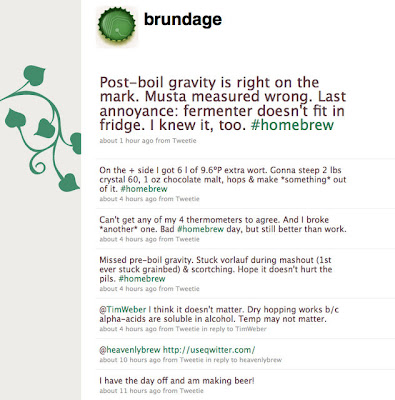 Today I brewed The Domestic for a second time. It is a Classic American Pilsner, also called a Pre-Prohibition Lager. The recipe is from Jamil Zainasheff's book Brewing Classic Styles.
- 12.5º Plato OG
- 80% German Pilsner
- 20% Flaked Maize
- Rest at 148ºF for 60 minutes
- Mash out to 160ºF
- Collect 11.5 gllons
- 2 oz 8.1% AA Perle FWH
- 0.5 oz 3.8% AA Czech Saaz 30 mins
- 1 oz 3.8% Czech Saaz 10 mins
My mash tun is direct-fired and I recirculate the wort to prevent scorching. During vorlauf today my flow rate slowed to a trickle. Most of the time the March pump loses prime and I goose it a little to get it going again. When that didn't work I stirred the grainbed and restarted the vorlauf. None of the usual tricks got the wort flowing again. But this was no ordinary problem.

That piece of hose pokes through the mash tun's false bottom, acting as the pick-up. Heat from the burner melted it partially closed. Wort in the bottom of my tun scorched from lack of movement.

The sparge marched onward and I collected 11.5 gallons of sweet wort. I measured the gravity at 9.6º Plato, or 1.038. At that strength my post-boil gravity comes out to 1.043; 7 points too low. Reducing the volume to hit the gravity posed two problems. First, the style demands a light-colored beer and a prolonged boil would darken it too much. Secondly, the first hops were in the kettle and would throw off the bitterness balance. I cursed a little, tweeted then pushed on.
Ninety minutes later the brew was boiled then chilled and in the fermenter. When I lowered it into the converted chest freezer the bulges of the keg would not fit. Previously, I had tried to put the keg in the freezer with the same result, so I should have known. I grumbled a little.

It is now in my ale fermentation cooler, turned up to full blast cooling. When it comes time to lager this baby, I'll split it into two carboys and put them in the freezer. Notice I hit my target starting gravity of 12.5º B.
After collecting the desired pre-boil volume I became curious how much wort I had left in the mash. Opening the spigot on the tun I dumped 6 liters of 9.6º B pale sweet wort into a bucket. With everything that went wrong today I was not about to waste so much potential beer.
Looking at my grain store, I picked an additional 2 lbs Crystal 60ºL and one ounce of chocolate malt. Approximating the recipe gives this:
- 2 lbs German Pilsner
- 2 lbs Crystal 60º L
- 1 oz Chocolate
- 0.3 oz 9.1% AA Centennial 60 mins
- 0.5 oz 9.1% AA Centennial 15 mins
- 0.5 oz 4.5% AA Fuggles 10 mins
- 0.5 oz 4.5 %AA Fuggles 1 min

The final gravity turned out to be 25.2º P (1.107). It will probably be an Imperial Stout-ish. The yeast is a German ale/kölsh strain coming right out of an Altbier I put into lager tonight. Hope it can handle high gravity.
As an aside, I am quite fond of the brew-in-a-bag method those Aussies invented. Tonight's second brewsession was essentially that.

Subscribe to:
Posts (Atom)
