Showing posts with label recipe. Show all posts

20 March, 2010

Alt Two


My second try at an Altbier turned out better than the first. Alt One got an infection from the MiniBrew plastic conicals I was using. A tragedy, because it tasted so good coming out of the kettle.

Alt Two is not my own recipe, but a concoction from Jamil Zainasheff's Brewing Classic Styles. Scaled up to 10 gallons the recipe is:

Fermentables

  • 18 lbs Pilsner
  • 2 lbs Munich
  • 0.5 lbs Debittered Black malt
  • 0.5 lbs Caramunich 60L
  • 6 oz Pale Chocolate malt 200L
Mashed starting at 151º, falling to 145ºF over the course of 60 minutes. (Need winter insulation for my mash tun.) Mash out at 160ºF. Sparge. Collected 12.5 gallons 11% B sweet wort. Boil 90 minutes.

Hops
  • 2.5 oz 8.1% AA Perle 60 minutes
Fermentation

Pitch a 1600ml starter of WLP 029 German Ale yeast into 14.3% B original gravity wort.

Fermented two weeks between 58º & 66ºF. Lagered for 26 days.

Notes
  • 2010-02-15 9.6%B Vinous notes
  • 2010-03-13 8%B Vinous flavors reduced. Ready to package.
It pours a deep copper brown with no appreciable head. Carbonation has not quite developed and I expect to get a good stand of foam in a few more days under pressure. There is roastyness up front and that vinous flavor refuses to disappear completely. This Alt puckers the mouth just a little, a problem attribute to poor scaling of the recipe from 5 to 10 gallons. The percentage of dark roasted malts may be too high. Bitterness is present and polite as appropriate for this malt-centric beer.

For my third Altbier I will find a common ground between One and Two. Not so much roasted malt as #2 and not so much Munich or Vienna as #1.

15 February, 2010

The Domestic & Something Else

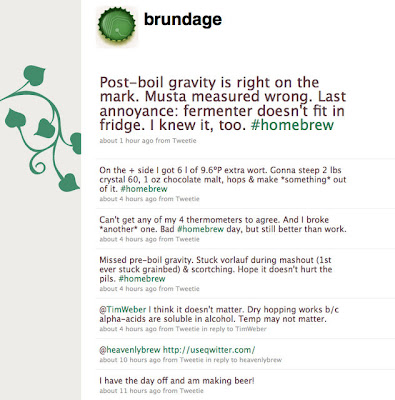
Read from the bottom up:

twitter feedToday I brewed The Domestic for a second time. It is a Classic American Pilsner, also called a Pre-Prohibition Lager. The recipe is from Jamil Zainasheff's book Brewing Classic Styles.

  • 12.5º Plato OG
  • 80% German Pilsner
  • 20% Flaked Maize
  • Rest at 148ºF for 60 minutes
  • Mash out to 160ºF
  • Collect 11.5 gllons
  • 2 oz 8.1% AA Perle FWH
  • 0.5 oz 3.8% AA Czech Saaz 30 mins
  • 1 oz 3.8% Czech Saaz 10 mins
I recently started doing a mash-out and this is my second brew session doing so. Combined with a slow sparge, I saw improved efficiency the first time. Today I ran into problems.

My mash tun is direct-fired and I recirculate the wort to prevent scorching. During vorlauf today my flow rate slowed to a trickle. Most of the time the March pump loses prime and I goose it a little to get it going again. When that didn't work I stirred the grainbed and restarted the vorlauf. None of the usual tricks got the wort flowing again. But this was no ordinary problem.


That piece of hose pokes through the mash tun's false bottom, acting as the pick-up. Heat from the burner melted it partially closed. Wort in the bottom of my tun scorched from lack of movement.


The sparge marched onward and I collected 11.5 gallons of sweet wort. I measured the gravity at 9.6º Plato, or 1.038. At that strength my post-boil gravity comes out to 1.043; 7 points too low. Reducing the volume to hit the gravity posed two problems. First, the style demands a light-colored beer and a prolonged boil would darken it too much. Secondly, the first hops were in the kettle and would throw off the bitterness balance. I cursed a little, tweeted then pushed on.

Ninety minutes later the brew was boiled then chilled and in the fermenter. When I lowered it into the converted chest freezer the bulges of the keg would not fit. Previously, I had tried to put the keg in the freezer with the same result, so I should have known. I grumbled a little.


It is now in my ale fermentation cooler, turned up to full blast cooling. When it comes time to lager this baby, I'll split it into two carboys and put them in the freezer. Notice I hit my target starting gravity of 12.5º B.

After collecting the desired pre-boil volume I became curious how much wort I had left in the mash. Opening the spigot on the tun I dumped 6 liters of 9.6º B pale sweet wort into a bucket. With everything that went wrong today I was not about to waste so much potential beer.

Looking at my grain store, I picked an additional 2 lbs Crystal 60ºL and one ounce of chocolate malt. Approximating the recipe gives this:
  • 2 lbs German Pilsner
  • 2 lbs Crystal 60º L
  • 1 oz Chocolate
Post-boil volume would be less than a gallon
  • 0.3 oz 9.1% AA Centennial 60 mins
  • 0.5 oz 9.1% AA Centennial 15 mins
  • 0.5 oz 4.5% AA Fuggles 10 mins
  • 0.5 oz 4.5 %AA Fuggles 1 min

The final gravity turned out to be 25.2º P (1.107). It will probably be an Imperial Stout-ish. The yeast is a German ale/kölsh strain coming right out of an Altbier I put into lager tonight. Hope it can handle high gravity.

As an aside, I am quite fond of the brew-in-a-bag method those Aussies invented. Tonight's second brewsession was essentially that.

21 September, 2009

Brown Fitzhenry Ale


My wife Adrienne was in need of some design services for a logo and business cards for her consulting services. Happily a friend of mine, Roby Fitzhenry, works for a first-class graphic design studio: Always Creative. The three of us met over beers at Revolution Bar one evening to hash out a deal. He would provide some branding and design services and we would make beer and replace a toilet in the Creative Space where he and I share offices. Roby likes Newcastle Brown so I started looking for recipes for a similar beer.

I found one in Graham Wheeler & Roger Protz's book Brew Classic European Beers At Home. This 180-page book is full of clone recipes from European breweries. Notable recipes include Fuller's ESB, Heller's Kölsch and Jenlain Bière de Garde. The book was a gift from my early brewing days and I do not often page through it. This time I was glad I owned it. On the Newcastle Brown ale clone page the authors write:

Newcastle Brown is a blend of two beers, a strong "vatted" ale and a weaker beer. The strong beer is matured in maturation tanks for a period of time and this is blended with a weaker and probably younger beer of OG 1030; the final blend having an OG of about 1045. Unique flavor characteristics that are only developed during the maturation of strong beers are then imparted to the strong beer, producing a full flavored beer for its gravity.
At their suggestion I brewed 5 gallons of OG 1.075 beer, blending it four weeks later with 10 gallons of OG 1.030 beer. This beer fermented and conditioned for a further three weeks to be put under pressure today. I have not taken a critical analysis of it yet, however Roby calls it "Fucking Delicious Ale" after he tasted it lukewarm and undercarbonated. Here's a pic of him trying to fit a cornie keg in his laptop bag to take home:


I will reproduce the single-batch recipe Wheeler and Protz provide, modified to fit ingredients I had on hand, and explain how they suggest splitting the batch.

5 US Gallons of Newcastle Brown Ale Clone

Fermentables
  • 5.75 lbs Pale
  • 1.15 lbs Crystal 60L
  • 12.5 oz sucrose
  • 1.1 oz Chocolate malt
I mashed for 90 minutes at 149° F where the book suggests 153°

Hops
  • 0.4 oz 8.9% AA Northern Brewer 90 mins
  • 0.6 oz 4.5% AA Fuggle 90 mins
(suggested) OG: 1.044, EBU: 24
(actual) FG: 7% brix

To make strong and week beers to blend, multiply the ingredients by 1.7 and 0.68 respectively. Blend one part strong with two parts weak. It was easiest to scale the recipe to 15 gallons, brewing 5 gallons strong with 10 gallons weak. I only promised 10 gallons to Roby so I get to keep 5 gallons for myself.

My brewery lacks a 15 gallon fermenter. A fellow brewer graciously loaned me a carboy so I could ferment the beer in three vessels. Upon kegging the beer I thought I noticed a flavor difference among the fermenters. I had my wife give me a triangle test and could pick the odd-beer-out. One was slightly maltier, but not significantly different. These beers were virtually identical and kept in identical environments, with few factors accounting for the flavor differences. This bolsters similar anecdotal evidence I found in my last split batch. Pitching rates matter.

17 September, 2009

Nettle Beer - A Beginning

Nettle tea helps promote kidney function, reducing the risk for kidney stones and gout. I get attacks of gout when I am not careful what I eat and many of my family members have kidney stones. I do not drink a lot of tea, and rather than changing my habits (putting me dangerously close to sounding old) I thought it more appropriate to get nettles elsewhere. Enter homebrew.

The cup of nettle tea I made to get a feel for the flavor tasted vegetal and slightly peppery. Few people, me included, want to drink beer that smells of boiled vegetables. My thinking went to covering it up with a healthy dose of American hops and some big malt. That was yesterday and I didn't have any Amarillo on hand... or yeast for that matter. The nearest LHBS is a day away by UPS. Because I was being interviewed for a homebrewing segment on the local news there were timing constraints. The beer had to be rolling at 2:30 when the reporter arrived. Not wanting to pay for overnight 10 AM delivery shipping I placed an order and crossed my fingers.

I should have known better. UPS usually delivers to my house around 7 PM. Not to worry, I wasn't really sure what kind of beer I would make today. Grabbing the first bag of hop pellets from the freezer, I settled on German Pearle. Next I went to the larder and ripped open new 55-lb bags of Vienna and Munich malt. Here's what happened:

3 gallons of Some Nettle Beer

Fermentables

  • 4 lbs Vienna
  • 2 lbs Munich
Doughed in 2 gallons of 160° F water (mostly RO with some tap water for "minerals"). The mash hit 157° F for 40 minutes. Using an ad-hoc brewing setup I batched sparged through a colander and collected a little more than 3 gallons of 10% brix sweet wort. So far so good. The reporter arrived right on time as the wort was starting to boil.

Bittering
  • 1 oz 8.1% AA Perle 60 minutes
  • 6 oz dried loose leaf nettles 60 minutes
I wasn't sure how much nettles to add - most of the recipes you find online measure by the fresh bucket or the peck. They went in until I had enough to almost overflow my kettle. By then the wort had a sharp nastiness to it signaling to me that it was a good time to stop.

We conducted the interview while the nastiness boiled. Right now I have just about 3 gallons of 13.6% brix wort cooling slowly as I wait for UPS to deliver some Safale US-05 yeast. The slow cool means that the resulting beer will have a lot of DMS, but it is a veggie beer to begin with.... Oh yeah, batch sparging with a colander causes a lot of splashing and hot-side aeration. Maybe my nettle beer won't start.

Looking forward to improving on this recipe with a little more preparation.

11 July, 2009

Tripel Digits

On June 20th I made an approximation of a Belgian tripel.

Tripel Digits

5 US gallons
OG: 18% Brix
FG: 8.8% Brix
IBU: ~30

Fermentables

  • 14 lbs 2-row
  • 1 lbs cane sugar
60 minute rest at 152° F. 60 metric minute boil.

Hops
  • 1 oz 8.1% AA Perle pellets 60 minutes
  • 1 oz 4.6% AA Saaz pellets 10 minutes
By the time I was done sparging I had 9 gallons of sweet wort and only enough fermentables for 5 (as planned). To get to my target volume I boiled for three hours. Not much harm in that except the beer will be a good deal darker than it is supposed to be.

Came out of the fermenter today nice and clear. Going to be about 10.75% ABV, but you can't really taste it. Tripels are like that. Another three weeks conditioning in the keg.

04 June, 2009

Rye Without The Hurricane

Last September, a day after Hurricane Ike demolished Galveston, I brewed a great rye beer I called Rye of the Hurricane. It was about 20% rye, 5% munich and 75% pale bittered with Mt Hood & Hallertauer hops. The beer came out with a great dry earthy bitterness from the rye and Mt Hood. Five gallons of that beer lasted seven weeks; these day's I'm lucky to get two weeks out of a keg.

Rye of the Hurricane II will be a very different beer. I increased the ratio of munich malt, and added crystal 120 to the grainbill. To balance the more intense malt flavors that the crystal adds I also stepped up the hopping schedule. Have a look. (Pictures here.)

Fermentables
9-gallons

  • 15 lbs Pale 2-row (Rahr)
  • 4 lbs Rye malt
  • 2 lbs Munich
  • 2 lbs Crystal 120L
Doughed in with 9 gallons of spring water to hit 150° F. Rested 20 minutes. Direct-fire heat to 163° F for another 40 minutes. Sparge with 170° F water to collect 10 gallons sweet wort.

Hops
60-minute boil
  • 2 oz 5.2% AA Mt Hood pellets first-wort hop
  • 1 oz 4.8% AA Kent Goldings pellets 30 mins
  • 1 oz 3.9% AA Hallertau pellets 10 mins
  • 1 oz 3.9% AA Hallertau pellets 5 mins
Wyeast 1318 London Ale Yeast III; Fermenting at 70° F.


The reason this beer is only 9 gallons is because I changed my strike water volume and forgot to compensate with extra sparge water. I wanted a thin mash - about 2 qts/lb to really pack this beer with malty goodness, but upon getting 11 gallons of strike water in my new mash tun I could see that adding in 23 pounds of grain would possibly overflow the vessel. I should have added the two missing gallons to the sparge to collect 11-ish gallons of sweet wort at completion of the mash.

The wort tasted awesome, simply fantastic. It's taking all my power not to keg & tap the beer this week - 9 days through fermentation. I hope I have the will to let it sit for another nine days, but I'm out of homebrew at the time. The bitter I made as a yeast starter for Gnarly Barleywine started out "meh" because I tapped it way too early. It became a nice beer near the end of the keg. I will keep that lesson in mind while I drink some commercial beer.

17 May, 2009

Barleywine, Bitter, Beer judging

Last Friday, minutes before leaving for a beer-judging weekend trip to Oakland, CA, I kegged this year's Gnarly Barleywine. Even though it has been four years since the first and last time I made this barleywine, I call it "this year's" barleywine because it is a good enough recipe that I would like to make it yearly. Brewed on May 6th, this beer's beginnings reach back another two weeks to a 10-gallon batch of Bitter I made as a yeast starter for the barleywine.

As I write this article, I sip the Starter Bitter. It's an ordinary bitter on the very low end of the SG range and the very high end of the IBU bracket. That combination of attributes makes for a bad beer. The bitterness is sharp and harsh and the body is thin. Adding calcium sulfate to RO water is about the only way to "fix" my tap water, but I think I overdid it this time. Sulfur compounds accentuate harsh bitterness. It is carbonic and metallic and a healthy dose of malt flavor would really bring this beer from the brink of disaster. The bouquet has some malt sweetness, but lacks hop aroma. Pardon me while I take another draught. Next time, five more pounds of Maris Ottr. The recipe:

10 gallons of Ordinary Bitter
Fermentables

  • 12 lbs Maris Ottr Pale
  • 2 lbs Crystal 60
90 minute rest at 149° F

Hops
  • 2 oz 7.6% AA pellet Brewer's Gold 60 minutes
  • 2 oz 5.25% AA whole EK Goldings 15 minutes
WYeast 1098 British Ale yeast. Ferment around 62° F.

A better mash program will probably help the malt profile. 149° F is at the top end of beta-amylase's temperature range, but below alpha-amylase. Beta makes fermentable sugars and alpha makes unfermentables. As John Palmer writes: "A lower mash temperature, less than or equal to 150°F, yields a thinner bodied, drier beer." That is exactly what I have; more malt please.

I should also note that higher fermentation temperatures will produce more of the British ester compounds that are missing from this beer.

The low starting gravity sure makes for a low-alcohol session beer. Pardon me while I pour another pint.

Moving along, the starter bitter fermented out and I transferred it to kegs. Onto the yeast cake I dumped 5 gallons of New Gnarly Barleywine:

Fermentables
  • 13.25 lbs Maris Ottr Pale
  • 2.25 lbs Honey Malt
  • 1.5 lbs Munich
  • 1 lbs Carapils Malt
  • 0.5 lbs Brown Malt
Mashed at 145° F for 60 minutes. Raised mash up to 160° F for another 30 minutes.

Hops (90 minute boil)
  • 1.5 oz 14.4% AA pellet Magnum first-wort
  • 1 oz 5.2% AA pellet Mt Hood 15 mins
  • 1 oz 5.2% AA pellet Mt Hood 5 mins
  • 2 oz 4.8% AA pellet EK Goldings 2 weeks dry hop
WYeast 1098 British Ale yeast. Ferment around 62° F.
OG: 1.092
FG: 1.018
IBU: 71 (est)

I was in a rush to get to the airport for this weekend's Longshot competition, therefore I did not get a proper taste on the way to the keg, nor did I add the dry-hops. Adding them will give me an opportunity to have a proper taste test.

Longshot was great, as usual. This marks my third year judging at the competition and reinforced my appreciation for the Boston Beer Company. My report from 2007 will give you an idea of what it's like. Incidentally, the best in show in our region went to a barleywine.


22 beers waiting to be judged best in show. The dude on the right is Pete Solsberg of Wicked Ale and gourmet chocolate fame. Real approachable guy - as are most brewers.

29 March, 2009

The Midnight Hour Brewery Goes Next-level

I purchased a used 3-tier stand yesterday from a local homebrewer. In brief, it is professionally welded 2" box iron. The vessels are all converted kegs with weldless quick-disconnect fittings. Propane is hard plumbed up the center support.

Before plunking down money Clint invited me to make a batch of beer with it. This is that beer's story.

Clint and I started heating strike water around 9:15 Saturday morning.

Fermentables:

  • 10 lbs Pale Malt
Doughed in with 1.3 qts/lb of RO and tap water to rest at 145° F for 30 minutes. Direct-fire heat to bring the temperature up to 160° F for another 30 minutes. Sparged with 170° water to collect about 6 gallons sweet wort. Boiled 60 minutes.

Hops:
  • 1 oz 7.9% AA whole Perle Hops first-wort hop
  • 1.5 oz 5.3% AA whole E.K. Goldings 30 mins
SafAle S-05 California Ale yeast

We were done and cleaned up by about noon-thirty, making a relatively quick brewday. OG was 14.6 °Brix with an estimated 51 IBUs. I call it Bitter Blonde.

I love the recirculating mash and all the direct-fire vessels. The mash tun and hot liquor tank have temperature probes for use with common digital oven thermometers. That gives me fine control over the mash, meaning when I find a recipe I like I can accurately record and recreate it. The kettle doesn't have a sight glass which is critical to me. Kettle volume combined with the gravity of the sweet wort is a guide to hitting target OG. My current 20 gallon aluminum kettle has a sight glass and fits on the bottom burner, so I will continue to use it (and I already have a prospective buyer for the keggle).

I also get a March pump with the deal, doubling the number of pumps I have. Now I have a spare mash tun and HLT which will go up for sale. It is a little sad to see my mash tun go because it is the second piece of homebrewing equipment I made - the first being an immersion chiller which was sold long ago.

Bitter Blonde is bubbling away in my 6.5 gallon carboy. Looking forward to tasting it and brewing again on my new brewstand.

08 March, 2009

Alt One

Altbier is one of my favorite styles of beer, and this is my first attempt at formulating a recipe for it. To prepare for this batch, I read Altbier: History, Brewing, Techniques, Recipes by Horst Dornbusch. The Classic Beer Style Series book came through with helpful explanations.

Fermentables:

  • 10 lbs German Pilsner
  • 3 lbs Munich
  • 3 lbs Vienna
  • 2 lbs Crystal 60
Using reverse-osmosis water treated with gypsum, I doughed in with 1 qt/lbs water to rest at 146° F for 30 minutes. Added boiling water to bring temperature to 160° F for 48 minutes. Sparged to collect around 14 gallons sweet wort.

Boiled 90 minutes.

Hops:
  • 3 oz 8.3% AA whole Perle 60 mins
  • 1 oz 3.3% AA pellet Hallertau Hersbrucker 10 mins
  • 2 oz 2.4% AA whole Hallertau Hersbrucker flameout
Chilled wort and pitched WYeast 1007, German Ale yeast. Fermenting at 63° F.

The second mash step went 18 minutes longer than I planned for. At that temperature alpha-amalyase is most active and beta-amalyase is denatured. Alpha-amalyase breaks down starch into unfermentable sugars and because of this the wort turned out quite sweet. The finished beer will likely turn out too malty for the style, but it won't turn out bad. I will find out in six weeks.

01 November, 2008

International Teach a Friend to Homebrew Day

Today is International Teach a Friend to Homebrew Day so I had a few friends over and made beer. Some of them knew how to brew, some of them did not, and one of the latter is gonna give it a try. I ended up making about 15 gallons of beer in two batches. Allow me to elaborate.

I bought ingredients for 10 gallons of AHS Evil Brown ale and everything was set to go at 10 o'clock this morning. There was one flaw in my plan, you see at the last club meeting we discussed Bryan/College Station water quality. It turns out that our water is simply awful for brewing - there's too much sodium and hardness. With this in mind I went down to Jacob's Well and got 20 gallons of reverse osmosis filtered water.

I know better than to brew with only RO water, and thought I had some Burton salts in my box of homebrew supplies. I did not. Nor did I use any tap water in my mash like I should have. My efficiency suffered severely because of this and I extracted 10 gallons of 1.022 wort where I should have seen 1.050-ish.

The remaining grains were still sweet so some of the other homebrews convinced me to do another batch. This time I added about a gallon of tap water to 5 gallons of RO. The mash went through starch conversion in about 15 minutes and I mashed for a total of 40. The resulting wort came out around 1.031 SG. I tossed some left-over Magnum and Goldings hops in the boil and split my yeast starter between the two fermenters. They are in the duck-in cooler right now.

So it took me two mashes and 15 gallons to get all the sugar out of my grains, but I like low-alcohol session beers. I'm curious to tast the brews.

The recipe:

Fermentables:

  • 18 lbs 2-row
  • 1 lbs Crystal 60
  • 0.5 lbs Chocolate Malt
Hops:
  • 2 oz 7.6% AA Brewer's Gold 60 mins
  • 1 oz 4.2% AA Goldings 15 mins
White Labs 005 English Ale yeast

Batch two used
  • 0.5 oz 14% AA German Magnum hops for 90 minutes
  • 1 oz 4.2% AA Goldings for 15 mins
I had those nagging cooling problems. Next time I will run my pump at a slower speed.

It was a great day. I even found the time to grill two racks of spare ribs and Adrienne made mozzarella. Other folks brought home and commercial brew meaning everyone was well fed and well drunk.

14 September, 2008

Rye of the Hurricane

Yesterday the eye of hurricane Ike passed 85 kilometers westward of my house in Bryan, TX. It caused no damage to speak of here. Our neighbors lost a tree, but after Adrienne and I helped him cut it down we waited out the storm with some spicy barley soup and laptops. We did not lose power or water like Galveston and wish a speedy recovery to them.

Today was brew-day. I had a crisp rye ale lined up from Austin Homebrew Supply and a starter of Wyeast 1968 ready to go. AHS advertised this recipe being similar to Real Ale's Full Moon Pale Rye, which I like. Bear Republic makes a great rye IPA and I would like to explore brewing with rye malt.


Had a few friends over to help share some (commercial) beer. The brew went by in a typical way. My efficiency is often quite low (50% today) so I topped off the recipe with a kilogram of dry malt extract. I got about 45 liters out of it which indicates that I sparge too much. OG was 12.8% brix with 41-ish IBUs. The recipe:

Fermentables:

  • 7.75 kg Pale malt
  • 2.0 kg Rye Malt
  • 1.0 kg Light Dry Malt Extract
  • 0.5 kg Munich Malt

Hops:
  • 110 g 5.3% AA Mt Hood (60 mins)
  • 55 g 1.5 % AA (!) Hallertauer (5 mins)

Wyeast 1968 London ESB Ale yeast.


Mashed 2.5 liters of water per kg at 65° C for 60 minutes. Sparged with 37 liters water to collect 51 liters of sweet wort. Measured the gravity to be 7.8% Brix.

I boiled for 30 minutes before adding the Mt Hood trying to get my volume down and gravity up. The wort has a nice sweetness to it, but I do not taste much rye. Chilling the wort is still a problem as I can only get down to about 32° C. When I put together a stand for my equipment I will make space for a pre-chiller. However, the brew is now fermenting in the duck-in cooler I made.

26 May, 2008

Creativespace ESB

I made 10 gallons of a simple ESB today, and it turned out fine. The ingredients came from Austin Homebrew Supply.

Fermentables

  • 17 lbs Maris Otter Pale
  • 1.5 lbs Crystal 60L
OG 10.75° Plato

Hops
  • 2 oz 7.7% AA Brewer's Gold (60 mins)
  • 2 ox 4.5% AA Yakima Goldings (15 mins)
Est 41.8 IBU

White Labs WLP002 English Ale yeast

What went well:
  • Brewday was quite smooth. I now have a great grasp of how my equipment works together and how to fit brewday tasks into the downtime between hop additions and mash stirrings.
  • I verified that water loss in my mash tun is acceptably small — less than half a gallon. I wondered about losses here because my manifold is not sweated together meaning that suction could be lost before collecting all the sweet wort.
  • I got about 65% efficiency out of my system, which is better than usual. I did a little better on the SG than suggested by Austin Homebrew.
  • The hand-drill paint stirrer is just awesome for aerating wort.
Concerns include:
  • The pitchable tube spent a day in the Texas heat because UPS doesn't knock very loud. It smelled a little funky when I opened it, but the starter was better.
  • I did not chill down to an ideal temperature before pitching. Threw the yeast into about 95° F wort. The fermenter is in a nice cool room now and I think the wort is cooler than last time.
For my readers looking for an update on the duck-in cooler, I made little progress since the last post. Too much weekend traveling. After the Longshot Competition judging this weekend, though, I will have time to finish it.

--Dean

06 April, 2008

First Brew-In


Weeks in advance the word went out through Craigslist, Facebook and TexAgs, trickling through emails from friend to friends. When brewday about 20 people showed to share beer, make beer, talk beer and have a good time. Three people brought their gear and we made 21 gallons of beer. I made an ordinary bitter, Ian made some hefeweizen, and a trio of brewers crafted chocolate raspberry stout.
I would say it was a great success. There was plenty of home and commercial brew going around and there was some great tri-tip off the bar-b-que. As is typical of many homebrew clubs, there was just a little bit of club business to discuss and a next meeting to decide on. Josh and Leslie volunteered their place for the next meeting and we quickly decided on May 3rd. I am pretty excited at the ease with which everyone got along and the eagerness of the group to continue gathering.

For 11 gallons of Ordinary Bitter:
Actual OG 1.034
Estimated IBU 26

Fermentables

  • 12 Lbs Crisp Maris Otter
  • 1.5 Lbs CaraMalt
Mash at 150° F with 1.7 quarts water per pound of grain for 90 minutes.

Hops
  • 1.0 oz 5.3% AA E.K. Goldings 90 minutes
  • 0.5 oz 9.0% AA Target (pellet) 90 minutes
  • 1.0 oz 5.3% AA E.K. Goldings 15 minutes
  • 1.0 oz 5.3% AA E.K. Goldings 1 minute
Starter of WYeast 1098, British Ale yeast.

My brew-day went smoothly until the end. My kettle screen let some hop leaves by and they got clogged somewhere leaving me with half-chilled wort. What I should have done was stop the chill, disassemble my apparatus and back-flush the system into the kettle. What I did instead was to dump the hot wort into the fermenter to air cool. I had to walk the fine line between pitching yeast into scalding wort and giving infection too much time to take hold. I think I pitched too hot because it took about 24 hours to see activity from a decent starter. I would really like to get my system hard-plumbed and on a stand.
I had two new gadgets to play with yesterday. The filter worked well once I realized it would be fine if I glued the casing together instead of worrying about replacing the filter after 10,000 gallons. I also bought a "Squirrel" brand paint mixer to aerate wort. That thing whipped up a six-inch head of foam in no time, making it a great purchase.

09 February, 2008

Where the Fuck Are My Hops Kölsch

First brew-day in Texas! There is no LHBS in B/CS so I ordered a Kölsch and a Bitter from Northern Brewer. I figured Kölsch is a good way to ease any megaswill-drinking new friends into good beer. Last night I went through boxes of packed equipment and retrieved what I need to brew. I had a nice starter ready. Everything looked set to go.

The recipe from NB:

Fermentables

  • 9 lbs Durst Pilsen
  • 1 lbs. Weyermann Pale Wheat
Hops
  • 1 oz. Argentina Cascade (60 min)
  • 1 oz. Argentina Cascade (30 min)

Wyeast #2565

I started the strike water around 11:30 (central time) just as a couple of my friends showed up to watch the process. When I went go get the ingredients from the cupboard I discovered that the hops were missing. Either I misplaced them or NB didn't ship them.... This was the perfect opportunity to introduce the guys to the homebrewer's creed: "Relax, don't worry, have a homebrew." Lacking homebrewed beer, I pulled out some Fancy Lawnmower ale from St Arnold's Brewery (a kölsch) and went for the ingredients from the bitter. EKG, Target, Magnum.... This won't quite make the BJCP standard definition of kölsch.

Hops
  • 0.75 oz 8% AA Target 60 mins
  • 1.00 oz 5% AA E.K. Goldings 30 mins
I also couldn't find my depth meter (an aluminum ruler), so I had to eyeball the amount of strike water. It turns out I had too much, leaving me with a dilute mash and not enough sparge water. My efficiency is way off because in the end I collected about 4 gallons of 11% brix wort.

I am glad to be making beer again, glad to have six or eight new friends (enough to start a homebrew club) to share the process with (in no small part because of the beer for them). I'll probably find those hops tomorrow.

24 December, 2007

Makin' Glögg

Glögg is a Swedish drink that we make yearly. Only last year, however, did we get serious about storing the finished product. Because of the added sugar it begins a very sweet drink - too much for me, but after a month becomes drinkable. Two weeks ago I opened 2006's batch. With age, it becomes smooth and spicy.

Last year I followed the recipe we have saved in the folds of The Joy of Cooking, but this year that book and recipe is packed away in preparation for our January move to Texas. Good thing Adie has an online copy.

I want to record the recipe I used this year so I can look back at it next year. I had to stray a little because the grocery store was out of a few things this morning (big surprise, Christmas Eve...)

In a saucepan mix:

  • A bottle of dry red wine. This year I used a $3 bottle of merlot.
  • Peel of a navel orange
  • 1/4 cup raisins
  • 1/4 cup prunes
  • 12 cinnamon sticks
  • 12 whole cloves
  • About a teaspoon of ground cardamom
Simmer for 15 minutes, then add
  • A bottle of ruby port
  • 1 c chopped almonds
Reduce heat to low, cover. In a pan heat over a medium flame
  • 1 cup sugar
  • 1/3 bottle Aquavit
Ignite the aquavit and burn until the sugar is dissolved. Add the remainder of the aquavit and cover to extinguish. Add this mixture to the mulled wine.

I left the glögg covered over low heat while I cleaned up, about 30 minutes. Strain out the mulling ingredients, bottle and label.

Skål!

17 June, 2007

Brew-in at the LHBS

Yesterday, the Sudzers held a brew-in at Beer & Winemakers, a local homebrew shop. It is a chance to get together with club members and show off your brewery. If you have read some of my previous posts you will know that my brewery is in transition from average-homebrew-size to double-homebrew-size. I have the big pieces of equipment, but not the stuff to efficiently connect the individual vessels. Despite this, and in defiance of previous infections, I packed most of my brewery into the car - resolute to make a full batch.

In order to take advantage of my shiny new counter-flow chiller and false bottom for my kettle, I needed to stop off at the hardware store. There I picked up some copper fittings and hose clamps to connect the kettle and CFC. Since it has been ten years since I last soldered copper, I hoped someone among the brewers there could refresh my memory. The beer path of my chiller was also a little tweaked from a storage accident and I feared the fittings might not set into place properly.

I arrived 20 minutes after the prescribed start to find only Roger St. Dennis set up and mashing. Always jovial, he greeted me and pointed to where I could set up. I was thankful to have a spot near the shade - the previous week was hot and sunny. There were customers, mostly neophyte brewers, checking out our equipment and asking questions about the process. I poured a beer from the jockey box.

Despite being determined to make beer that day, I did not have a recipe. I am beginning a search for a stellar bitter recipe and the owner at B&WM helped me get a start. Off the top of his head, he recommended these ingredients:

Fermentables

  • 20 lbs Maris Otter
  • 2 lbs Crystal 35L
Hops
  • 3.0 oz Goldings 5.1%AA 60 min
  • 1.0 oz Goldings 5.1%AA 10 min
I choose White Labs Dry English Ale yeast and the hopping schedule. I poured a beer from the jockey box.

He erred towards the malty side, but even with my brewery's 68% efficiency that put the OG -about 1.056 - well above range for an ordinary bitter. I could have used half the fermentables and come out at the low end of the gravity range. Not to worry - I like big beers too.

I heated 9 gallons of strike water to about 160° F and mashed in. The only thermometer I brought that day had a tiny dial, so these readings are approximate. I hit around 155° F for my sacc rest and called it good. I poured a beer from the jockey box. While the hot water did its thing, I chatted with customers and set about other brew-day tasks.

Since my 15-gallon fermenter does not travel well, I resorted to two dirty 5-gallon glass fermenters. Cleaning those bottle-necked vessles is a real pain in the ass, but PBW worked well for me. Another beer from the jockey-box. Many people asked questions and I was happy to explain the whole brewing process.

Even with the extra distractions, I remembered to heat up some sparge water in time for mash-out. My crappy software recommended 8 gallons sparge water, but I only brought a 5-gallon HLT. I decided to make due and heat two batches of water to get the correct volume. The first was ready on time and the second shortly afterwards. The brew-day was quickly progressing. I poured a beer from the jockey box.

While waiting for the kettle to boil, I talked with a machinist about how to best handle my bent chiller outlet. We decided that it would be best to shove a hose way up onto a more sturdy part of the outlet and clamp it down. This worked and I was able to solder a hose-barb on to the other end; ugly, but water-tight. I poured a beer from the jockey box.


Hops were added according to schedule and fermenters were sanitized in time. The new chiller worked superbly and I employed ye ol' shake the fermenter for aeration trick. 30 minutes later, my equipment was clean and put away in the car. The bar-b-que was going and I relaxed until my brew-day buzz wore off before driving home.

Twenty-four hours later, one fermenter is running and the other is just picking up steam. (I think one got more O2 than the other.) I have a crawl-space that maintains about 70° F which should produce a fruity ale. I will report on the process as newsworthy events develop.

--Dean

12 March, 2007

Introducing the Midnight Hour Brewery

I have been brewing since February of ought-four. I have a blog here, and occasionally here, but I want to do a dedicated brewing one.

All breweries, no matter how small, need a name. That idea had not yet crossed my mind when I took up all-grain brewing around my 4th batch. As you may know, all-grain beer takes quite a bit more time than making simple extract & specialty grain. In those days it did not matter how early I started the strike water, clean up wouldn’t end ’till midnight or afterwards. It was a bit of inexperience and a bit my style. So, when I decided that I needed a name for my brewery, I picked the Midnight Hour Brewery to remind me to attempt an earlier finish.

Now-a-days I do not finish so late on a typical brew day. My last batch, however, was another late-night finish. It had been five months or so since I made beer and I was really feeling the desire to brew. Finally I decided to play hookey and make beer. I whipped up a recipe for three gallons of Bohemian Pilsner.

Fermentables (est 1.056 OG)

  • 1.5 lbs Vienna Malt 1.037, 3°L
  • 5.0 lbs Lager Malt 1.037, 1°L
Hops (est 45.6 IBU)
  • 1.5 oz Tettanger 4%AA 60 mins
  • 1.0 oz Tettanger 4%AA 10 mins
  • 1.0 oz Tettanger 4%AA flameout
White Labs Czech Budejovice Lager yeast & distilled water.

Why the small finish volume? My kettle is out on loan for one thing, but I am also in the middle of building a stand for some new equipment I got for Christmas and my birthday. I got a great deal on some 15-gallon MiniBrew conical fermenters on EBay earlier last year, but they stand about four-foot-six off the ground. To get the chilled wort in there I would have to lift my 20-gallon kettle full of just-boiled liquid to the top of my pickup’s camper shell and put the chiller on a milk-crate on the tail gate. That crap had to stop, so I got a pump for my BD. A nifty false bottom, a mega burner, an upgraded CFC and a grain mill came for Christmas and at that point I needed to put together a way to chain it all together. So my brewery is in pieces right now, explaining the infrequent and small batches.

The Pilsner was a frustrating process. I decided to do a two-step infusion mash instead of my normal single step mash. I had problems hitting my rest temperatures, mashing at 155° F instead of 162° F like I wanted to. I also collected 5 gallons 1.023, putting my original gravity around 1.059 for 3 gallons, and a two hour boil. That’s a little outside the style guidelines for Bohemian Pilsner, but I wanted it at the high end of that gravity range, and it was the long boil that troubled me.

When I sanitized my new chiller, I discovered that I did not have the right hose diameter to get enough suction and clamps probably would have deformed the soft coper of my new chiller. I had already sold my old CFC to the person who also had my kettle, so I had to chill overnight.

At present, the brew is fermenting away at 50° F so it appears there were no infections. Now I have to wait out a 10 week lager for it to be ready. I’ll probably have my stand done before then, then it’s back to consistent, 10-gallon batches.

–Dean