15 February, 2010

The Domestic & Something Else

Read from the bottom up:
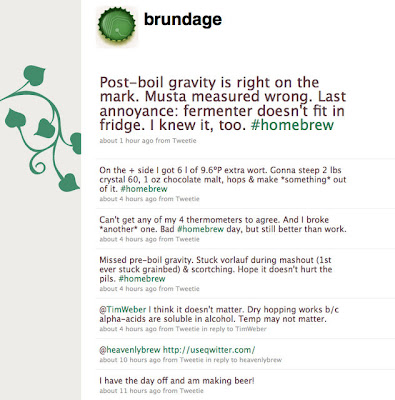
twitter feedToday I brewed The Domestic for a second time. It is a Classic American Pilsner, also called a Pre-Prohibition Lager. The recipe is from Jamil Zainasheff's book Brewing Classic Styles.

  • 12.5º Plato OG
  • 80% German Pilsner
  • 20% Flaked Maize
  • Rest at 148ºF for 60 minutes
  • Mash out to 160ºF
  • Collect 11.5 gllons
  • 2 oz 8.1% AA Perle FWH
  • 0.5 oz 3.8% AA Czech Saaz 30 mins
  • 1 oz 3.8% Czech Saaz 10 mins
I recently started doing a mash-out and this is my second brew session doing so. Combined with a slow sparge, I saw improved efficiency the first time. Today I ran into problems.

My mash tun is direct-fired and I recirculate the wort to prevent scorching. During vorlauf today my flow rate slowed to a trickle. Most of the time the March pump loses prime and I goose it a little to get it going again. When that didn't work I stirred the grainbed and restarted the vorlauf. None of the usual tricks got the wort flowing again. But this was no ordinary problem.


That piece of hose pokes through the mash tun's false bottom, acting as the pick-up. Heat from the burner melted it partially closed. Wort in the bottom of my tun scorched from lack of movement.


The sparge marched onward and I collected 11.5 gallons of sweet wort. I measured the gravity at 9.6º Plato, or 1.038. At that strength my post-boil gravity comes out to 1.043; 7 points too low. Reducing the volume to hit the gravity posed two problems. First, the style demands a light-colored beer and a prolonged boil would darken it too much. Secondly, the first hops were in the kettle and would throw off the bitterness balance. I cursed a little, tweeted then pushed on.

Ninety minutes later the brew was boiled then chilled and in the fermenter. When I lowered it into the converted chest freezer the bulges of the keg would not fit. Previously, I had tried to put the keg in the freezer with the same result, so I should have known. I grumbled a little.


It is now in my ale fermentation cooler, turned up to full blast cooling. When it comes time to lager this baby, I'll split it into two carboys and put them in the freezer. Notice I hit my target starting gravity of 12.5º B.

After collecting the desired pre-boil volume I became curious how much wort I had left in the mash. Opening the spigot on the tun I dumped 6 liters of 9.6º B pale sweet wort into a bucket. With everything that went wrong today I was not about to waste so much potential beer.

Looking at my grain store, I picked an additional 2 lbs Crystal 60ºL and one ounce of chocolate malt. Approximating the recipe gives this:
  • 2 lbs German Pilsner
  • 2 lbs Crystal 60º L
  • 1 oz Chocolate
Post-boil volume would be less than a gallon
  • 0.3 oz 9.1% AA Centennial 60 mins
  • 0.5 oz 9.1% AA Centennial 15 mins
  • 0.5 oz 4.5% AA Fuggles 10 mins
  • 0.5 oz 4.5 %AA Fuggles 1 min

The final gravity turned out to be 25.2º P (1.107). It will probably be an Imperial Stout-ish. The yeast is a German ale/kölsh strain coming right out of an Altbier I put into lager tonight. Hope it can handle high gravity.

As an aside, I am quite fond of the brew-in-a-bag method those Aussies invented. Tonight's second brewsession was essentially that.

29 December, 2009

New Site For Brewing Questions: BrewAdvice.com

A few people I follow on Twitter set up a nifty new site designed around brewing questions. Using technology from StackOverflow the best answers bubble up to the top of each question, meaning you need not search through a lengthy forum post to find the right answer.

Surf on over to BrewAdvice or check out my profile there.

09 December, 2009

Basic Equipment

One of my friends asked what equipment she should get her boyfriend so he could start making beer. There are many equipment articles out there and here is one more

Note: If I were to write this up again, I would recommend the Australian brew-in-a-bag method rather than all the all-grain equipment.

I don't know what your budget is... you can easily spend a few hundred dollars for a good kitchen setup.

The Minimum:

A large pot. Stainless steel is best, but aluminum is cheap. Like I said before, at least 2 gallons. The bigger, the better. Best is 6 gallons so he can do a full-wort boil where he doesn't have to top off the fermenter with tap water. Boiling 5 gallons of wort on a kitchen stove is a big pain though, consider getting one of those turkey fryer burner deals. The one I used to have was a 7-gallon aluminum pot and a burner. Never did fry a turkey.

A fermenter. Go for the 6 gallon variety. I used glass carboys, but I have heard very good things about the Better Bottle. If I needed another (cheap) fermenter, I'd try one out. The homebrew shop will probably tell you need a primary & secondary fermenter, but that's a big myth. I do my fermentations in a single vessel and make pretty good (damn good) beer. Politely decline.

Transfer tubing, bottling wand and a racking cane. Not too much to say here - the homebrew shop will know what you need. I recommend a stainless steel racking cane over a plastic one. It's worth the extra money.

A bottling bucket.

Bottles. Five gallons of beer fills a little fewer than fifty bottles.

Sanitizer. Go for the "no rinse" variety. I switch between iodophor and 5-Star to keep the nasties on their toes. Buy in bulk.

Testing equipment. A floating thermometer or a digital thermometer on a probe. Also a hydrometer and a cheap graduated cylinder to take specific gravity readings in. Long ago I ditched the cylinder & hydrometer in favor of a refractometer. Really worth the extra money (but maybe only if you've been using a hydrometer for a while :-)

That equipment will be enough to get him started doing "extract with specialty grain" (also incorrectly known as "partial mash") brewing. The recipe kits are classified by the level of equipment you have. Since he's got some brewery experience he will probably want to get into "all grain" brewing pretty soon. All of the above equipment will serve for that purpose, plus a few additional pieces.

All Grain

You definitely need the full sized pot.

A hot liquor tank (HLT). Ideally this is a vessel you can heat, but anything that keeps 3-5 gallons of hot water is fine. Many people use Rubbermaid or Gott coolers.

A mash tun. This is a vessel to hold the grain and hot water for making sweet wort. It's slightly specialized because you need a filter at the bottom used to separate the sweet wort from the spent grain. If either of you is crafty you can make one on the cheap. Mine was a large cooler with the drain plug removed replaced by some copper fittings. Some rigid copper tubing with small holes drilled in it sat in the bottom connected to a brass ball valve on the outside. Served me well for five years.

Here's a good shot of my previous all-grain setup. Left to right in the picture is a 5-gallon aluminum pot that I punched a hole in for the drain and spigot. It served as my HLT. Next is my mash tun which I described above. Lastly is a 10-gallon aluminum pot sitting on a burner. It also has a drain and spigot.


Consider a subscription to Zymmurgy or BYO Magazine. One of the books I recommend to everyone is Designing Great Beers. Really helped me understand the process.

Get involved in a homebrew club. They are the best places to learn the hobby. There are at least two in Oakland: The Draught Board & Bay Area Mashers (BAM). If you go to a Draught Board meeting tell Roger St Dennis I say hi.

I've gone on for a while now. There are a billion other brewing resources on the web.

21 October, 2009

Triple Digits Tasting Notes

Triple Digits is gone. It was good with room for improvement. The hop bitterness was a little harsh and it should bee lighter. Here are some tasting notes:

  • spicy clove phenolics
  • alcohol warmth
  • yeast aroma
  • fine, thin head
  • effervescent
  • creamy malt, finishing dry
  • medium body
  • earthy hop bitterness lingers in the back of your throat

20 October, 2009

Oktoberfest At Christopher's World Grille

Thanks to everyone for coming out to see me talk at Christopher's tonight. For an Italian, he makes some delicious German food.

If you want to know more about making beer at home, read this post and come out for Teach A Friend to Homebrew Day on November 7th. The Texas Aggieland Brew Club will be making beer in front of the Village Cafe/Art 979 Gallery in downtown Bryan starting at 11am. If you can't make that we hold regular meetings on the third Friday of the month. We are organized through Facebook only right now, but if you get in touch with me I will make sure you know what is going on.

I hope you enjoyed the dinner as much as I did. I can do the same for your restaurant. I also train staff and give general beer menu advice. Drop me an email.